
Layered Kitchen Lighting: Why It Matters in 2026 Remodels
Most 2026 kitchen remodels won’t fail because of cabinet choices or countertop materials—they’ll fall short because the lighting was an afterthought. After thousands of dollars spent on quartz slabs and custom cabinetry, homeowners flip the switch and find themselves squinting at shadows on their prep surfaces or hosting dinner parties under harsh, unflattering overhead glare. The fix isn’t complicated, but it requires thinking about light as a system rather than a single overhead fixture.
Layered lighting combines ambient, task, and accent light into a cohesive plan where each layer handles a specific job. Instead of one central kitchen ceiling fixture doing all the work (and doing it poorly), you distribute multiple light sources across the room, each controlled independently to match how you’re using the space at any given moment.
- USA-based remodelers now routinely specify 3–5 different fixture types in a single kitchen, including recessed lighting, pendant lights, under cabinet lighting, toe-kick strips, and in-cabinet LEDs
- This approach supports the way modern kitchens actually function: as spaces for cooking, homework, entertaining, and late-night snacking
- The result is a room that feels larger, works harder, and adapts to morning coffee brightness or evening dinner ambiance with the touch of a dimmer
- Modern must-haves we’ll cover include toe-kick lighting for nighttime navigation, in-cabinet lighting for displaying collections, and smart dimmers that let you create one-touch scenes
This layered lighting guide walks through everything you need to plan a kitchen that works as beautifully at 6 a.m. as it does during a dinner party.
The Three Layers of Kitchen Lighting: Ambient, Task, Accent
Layered lighting isn’t a vague design philosophy—it’s a practical framework where ambient lighting fills the whole room, task lighting illuminates work surfaces, and accent lighting adds depth and character. Every successful lighting plan starts by mapping these three layers onto a floor plan before a single fixture is purchased.
Consider a typical 12×16 ft family kitchen with an island, perimeter cabinetry, and a small breakfast nook. Each zone needs different light at different times. The ambient layer makes the entire space navigable. The task layer ensures you can chop onions without shadows. The accent layer highlights your backsplash and creates visual interest after the sun goes down.
- Each layer should operate on its own switch or dimmer switches for maximum control
- Without separation, you’re stuck with “all on” or “all off”—no flexibility for mood or function
- The following sections break down exactly what each layer does and which fixtures deliver it best
Ambient Lighting: The Foundation Layer
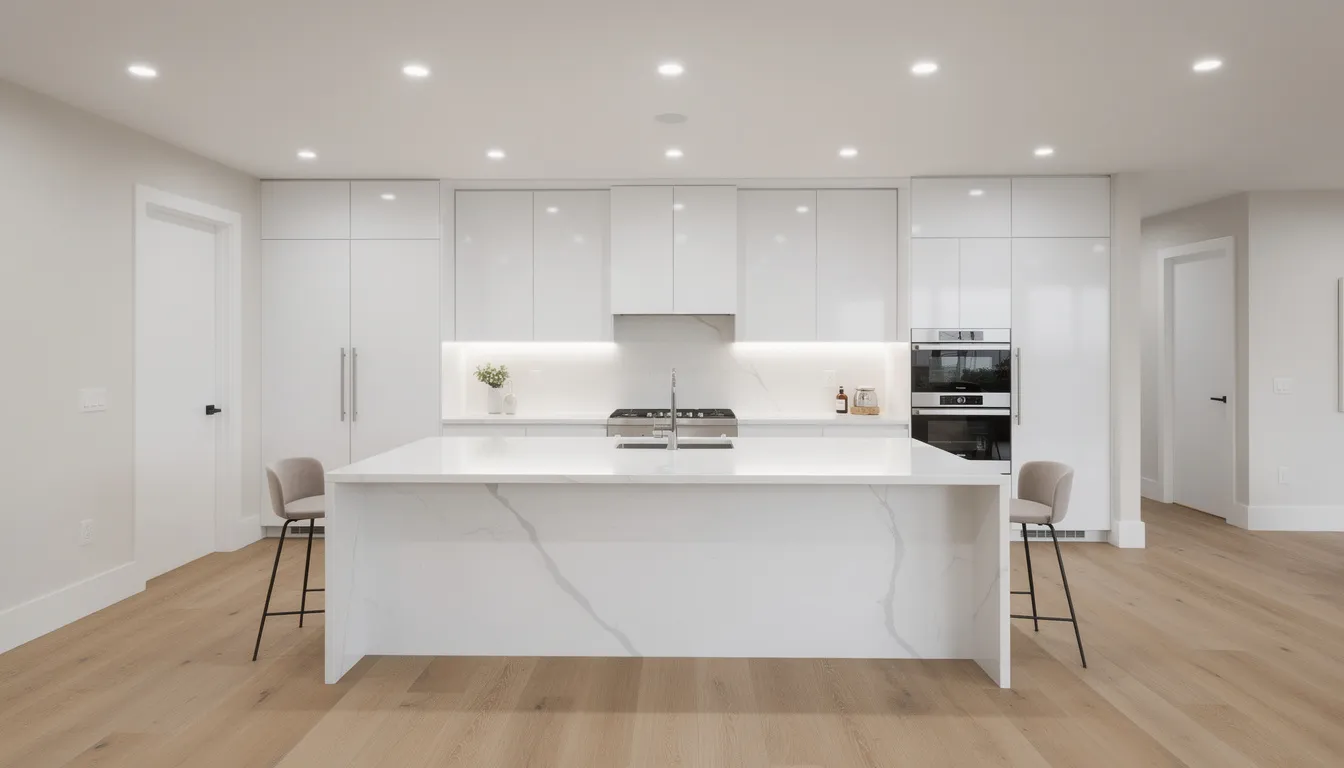
Ambient lighting is the room-filling light that lets you move safely and see overall surfaces without straining. Think of it as the baseline that makes the kitchen feel open rather than cave-like.
- Typical fixtures include recessed downlights (the workhorses of modern kitchens), central flush or semi-flush mounts, and linear chandelier options over islands that contribute ambient illumination while serving as focal points
- In a 10×14 ft galley kitchen, plan for 6–8 LED recessed cans spaced about 4–5 ft apart in two rows for even coverage
- Target about 30–40 lumens per square foot of total kitchen light, with ambient providing roughly half of that baseline
- Fixtures should be dimmable so you can soften the room for evening entertaining while still having full brightness available for deep cleaning
- This foundation layer creates the sense of space and prevents the shadowy corners that make kitchens feel cramped
Task Lighting: Precision for Prep and Cooking
Task lighting delivers focused light to the specific work zones where you chop vegetables, read recipes, and scrub pans. Without it, you’re working in your own shadow no matter how bright the ceiling feels.
- Under cabinet lighting is the primary task layer for countertops—LED strip lights or rigid bar lights mounted toward the front of the cabinet underside eliminate shadows on work surfaces
- Pendant lights above islands should be bright enough to function as task lighting when you’re rolling dough or assembling ingredients, not just decorative elements
- Aim for 3000K–3500K color temperature for task zones, which provides crisp visibility without the harsh clinical feel of cooler temps
- Target about 50–75 lumens per square foot on active work surfaces
- Concrete example: a 7 ft island with three pendants, each using a 60–75W equivalent LED bulb, delivers effective direct light for meal prep while still looking proportional to the space
- Task lighting is non-negotiable for safety—proper illumination prevents knife slips and helps you spot when food is properly cooked
Accent Lighting: Depth, Character, and Drama
Accent lighting highlights architectural features, backsplashes, open shelving, and artwork to add drama and dimension beyond the functional layers. This is where your kitchen develops personality.
- Toe-kick lighting (LED strips recessed at the base of cabinets) creates a “floating cabinet” effect and doubles as navigation light for midnight kitchen visits
- In-cabinet lighting for glass-front uppers, bar areas, and display niches transforms functional storage into a showpiece using low-wattage LED strips or pucks
- Accent lights typically run at 10–20 lumens per square foot of the highlighted area—much softer than task or ambient layers
- These fixtures are usually dimmable so they can glow softly in the background or brighten slightly for entertaining
- Example: an LED strip running under the edge of a quartz waterfall island visually separates the island from the floor, adding depth and a subtle luxury feel
- Wall sconces near a breakfast nook or dining area provide warm, decorative accents that contribute to the layered scheme
Kitchen Lighting Ideas by Zone: From Ceiling to Toe-Kicks
The most useful kitchen lighting ideas focus on zones rather than fixtures in isolation. Instead of asking “what chandelier should I buy?” the better question is “what does my island need to do, and what light supports that?”
USA homeowners increasingly treat each zone—island, perimeter counters, sink, dining nook, and floor-level navigation—as its own mini lighting plan with dedicated switches and dimmers. This zone-based thinking makes it easier to plan and easier to live with.
- Island zone: multi-purpose area needing flexible pendant lights for prep, homework, and casual meals
- Perimeter counters: primary workspace requiring shadow-free under cabinet lighting
- Sink area: dedicated task lighting for washing and food prep
- Dining nook: softer ambient and accent fixtures for meals and conversation
- Floor level: toe-kick and night lighting for safety and ambiance
The following sections walk through fixture types and placement for each functional area.
Island and Peninsula Lighting: Pendants that Work Hard
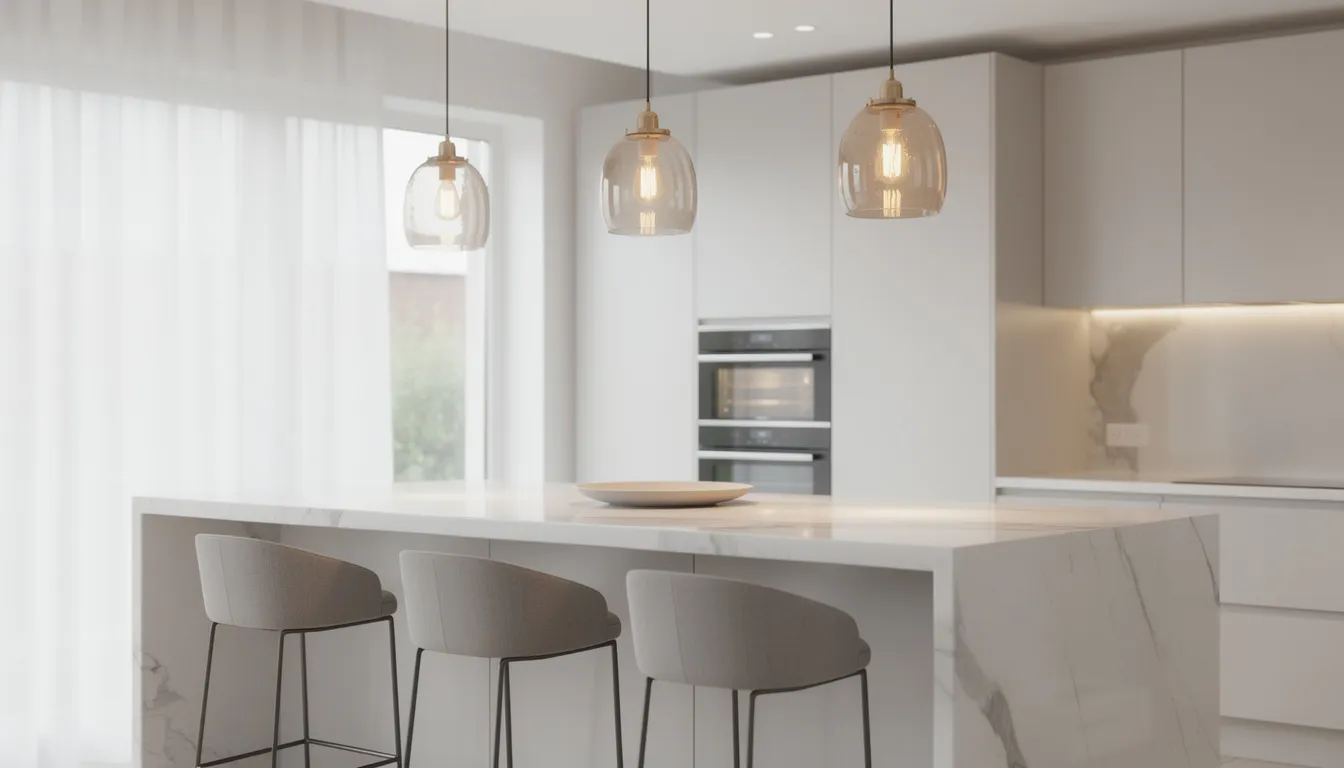
Islands act as the multi-purpose heart of modern kitchens—prep station, homework desk, coffee bar, and gathering spot. The pendant lights you hang here need to work as hard as the island itself.
Classic hanging rules provide the foundation for visual harmony:
- Hang pendants 30–36 inches above the countertop surface for comfortable sightlines and effective illumination
- Space multiple pendants 24–30 inches apart, with at least 6 inches of clearance from island ends
- For a 7–8 ft island, use three 10–12 inch diameter pendants, or substitute a single 40–48 inch linear fixture for cleaner sightlines in contemporary spaces
- Popular 2025–2026 trends include minimalist linear pendants in matte black, brushed brass finishes, or white, plus clusters of small glass globes for a lighter look
- Pendants should connect to a dimmer separate from recessed lighting so you can shift from bright prep mode to softer entertaining without affecting the rest of the room
- Adjustable fixtures allow you to fine-tune height after installation if the initial placement doesn’t feel right
Under Cabinet Lighting: The Essential Task Layer
Under cabinet lighting is the single most transformative upgrade in modern kitchen remodels. It turns shadowy countertops into well-lit workspaces and makes the entire kitchen feel more finished and intentional.
This cabinet lighting option comes in two main formats:
- Continuous LED strip lights provide the most even illumination and are preferred for seamless counter coverage
- Evenly spaced LED bar lights (also called light bars) mount toward the front cabinet rail and offer easier installation in retrofit situations
- Choose 3000K–3500K color temperature and high CRI (90+) so food and finishes look accurate on quartz, granite, and butcher block surfaces
- Wire under cabinet lighting to a wall switch with an integral dimmer for a clean, professional installation—avoid plug-in strips visible from normal sight lines
- For 10 linear feet of upper cabinets, aim for continuous dimmable LED strips producing 400–600 lumens per linear foot
- Mount strips toward the front of the cabinet underside, not against the wall, to throw light onto the work surface rather than the backsplash
In-Cabinet and Shelf Lighting: Showpieces and Storage
In-cabinet lighting has grown in popularity for glass-front uppers, bar cabinets with glassware displays, and deep pantry units where standard room lighting doesn’t penetrate.
- Miniature LED puck lights mounted at the top of a cabinet cast focused light downward onto contents
- Vertical strip lights along face frames create an elegant glow visible through glass doors
- Rear-mounted strips positioned behind glassware create a backlit effect that highlights the materials and adds atmosphere
- In-cabinet lighting typically runs warmer (2700K–3000K) than task lighting to create a cozy, display-like effect rather than clinical brightness
- Example: integrated vertical LED strips inside a full-height pantry cabinet that activate automatically with a door-activated switch—you see everything instantly without fumbling for a wall switch
- These fixtures consume minimal energy (often under 5 watts per foot) and add substantial visual interest without overwhelming the room
Toe-Kick and Night Lighting: Subtle but Powerful
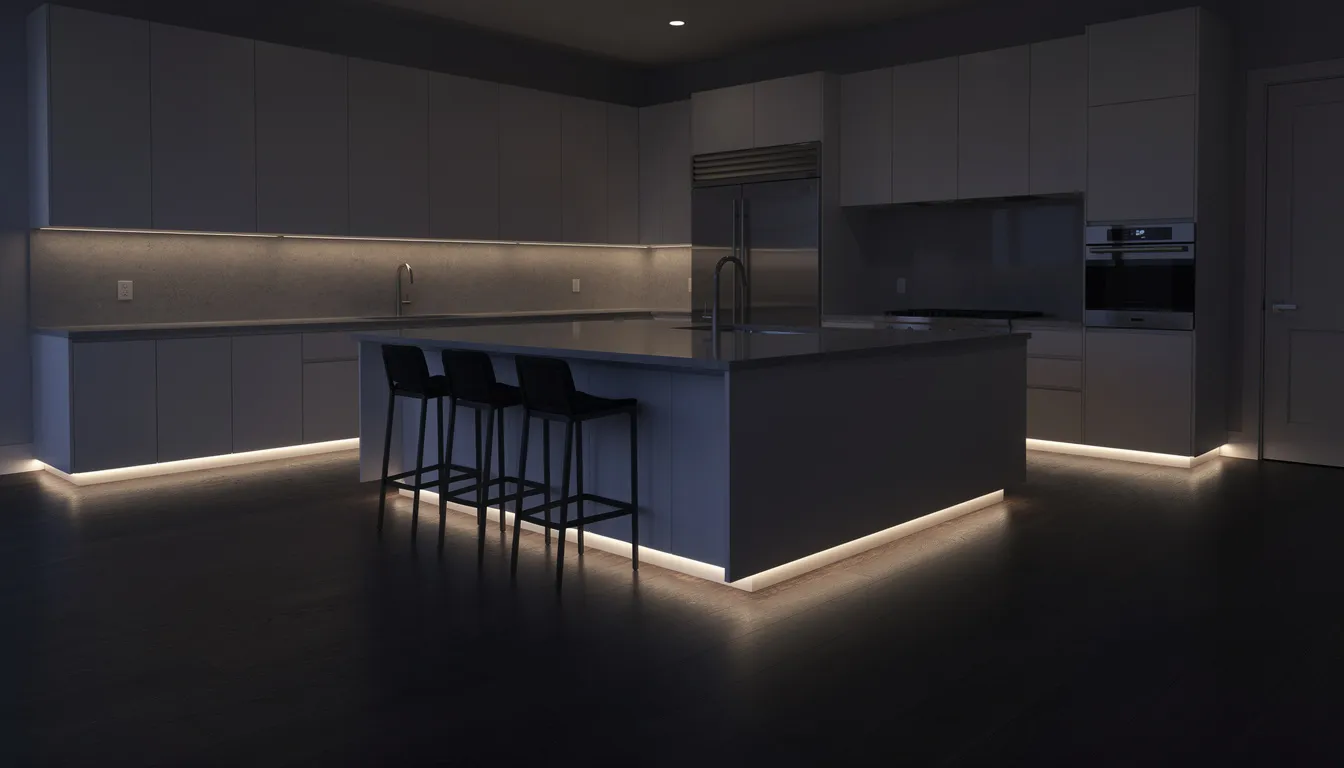
Toe-kick lighting has emerged as a trending accent that doubles as a safety feature for nighttime trips to the kitchen. It transforms the base of your cabinetry into a subtle navigational guide.
- Low-wattage LED strip lights recess into the toe-kick (the 4–6 inch plinth below base cabinets) or mount just behind a small reveal to hide the light source completely
- Motion sensors or time-based smart scenes bring toe-kick lighting on at 10–20% brightness after dark, providing enough light to navigate without waking your eyes up fully
- Warm 2700K LED strips along the base of island cabinets and sink wall create soft, indirect glow that makes the space feel welcoming
- The effect makes cabinets appear to float slightly above the floor, adding depth and a spa-like ambiance to the kitchen
- Toe-kick lights pair naturally with other layers—when ambient and task lighting are off, they provide just enough illumination for a glass of water at 2 a.m.
Choosing the Right Color Temperature and Brightness
Color temperature, measured in Kelvin (K), determines whether your kitchen feels warm and inviting or cool and clinical. It affects how food, finishes, and even skin tones appear under your lighting—making it one of the most important decisions in your lighting plan.
The scale runs from warm amber tones at the low end to cool bluish-white at the high end:
- 2700K produces warm, incandescent-like light similar to candlelight—cozy but sometimes too yellow for task work
- 3000K–3500K delivers warm white to neutral tones, the sweet spot for most kitchens
- 4000K and above feels cooler and crisper, better suited to clinical or commercial environments than residential kitchens
Kitchens typically work best at 3000K–3500K, where you get enough warmth to make the space feel comfortable while maintaining enough crispness for accurate food prep. Aim for around 30–40 lumens per square foot overall, with brighter spots concentrated on prep zones and slightly softer levels over seating areas.
Kelvin Guidelines: Kitchens vs. Baths
Many USA homeowners regret choosing overly cool (5000K+) lighting in kitchens because it creates a harsh, clinical atmosphere that makes food look unappetizing and family members look tired.
- Recommend 3000K for cozy family kitchens with lots of wood tones and warm finishes—it complements bronze, warm brass, and natural materials beautifully
- Use 3500K for modern white or gray kitchens that need a crisp but inviting feel without veering into coldness
- Bathrooms can lean cooler (3500K–4000K) over vanities where grooming tasks like shaving and makeup application benefit from accurate color rendering
- Keep all fixed kitchen light fixtures in the same Kelvin temperature to avoid mismatched color cast on counters and walls—mixing 2700K pendants with 4000K recessed lighting creates an uncomfortable visual disconnect
- Tunable white LED systems (often called CCT tunable) allow homeowners to shift between warm and cool for morning energy versus evening relaxation
Brightness, Lumens, and CRI for Real-World Kitchens
Wattage is no longer a reliable measure of brightness with LED technology. Homeowners should focus on lumens (light output) and CRI (Color Rendering Index, which measures how accurately colors appear).
- Target about 3,000–5,000 total lumens for a small 10×10 ft kitchen
- Larger 12×18 ft kitchens need 6,000–8,000 total lumens for adequate illumination across all layers
- CRI of 90 or higher is ideal for showing true colors of cabinetry, countertops, and fresh ingredients—lower CRI makes everything look slightly off
- Use brighter recessed downlights (800–1,000 lumens each) on dimmers so they can be tuned down for dining areas and entertaining
- When comparing bulb type options, verify both lumen output and CRI on the specification sheet before purchasing
Smart Controls, Dimmers, and Kitchen Lighting Scenes
Smart lighting controls have become a core part of any modern layered lighting guide, not an optional tech upgrade. When you have 3–5 different lighting zones, managing them all becomes impractical without some level of automation or scene control.
Dimmers alone deliver significant benefits: they extend fixture longevity, reduce energy consumption by up to 40%, and adjust the mood from chef-level brightness to restaurant-soft ambiance. Smart switches take this further by letting you save and recall specific dimming combinations with a single tap or voice command.
- Homeowners commonly create named scenes like “Cooking,” “Cleanup,” “Family Dinner,” and “Nightlight” for one-touch control of all layers simultaneously
- Smart switches can control standard fixtures, so you don’t necessarily need expensive smart bulbs in every socket
- The goal is flexibility—being able to transform the room from a bright workspace to a warm gathering space in seconds
Basic Control Strategy for a Layered Kitchen
A well-planned kitchen needs at least 3–5 separate lighting zones on individual switches or dimmers to support the layered concept.
- Zone 1: Ambient ceiling lights (recessed lighting or flush mounts)
- Zone 2: Island pendants
- Zone 3: Under cabinet lighting
- Zone 4: Toe-kick or night lights
- Zone 5: Dining room or breakfast nook fixture
- Grouping task lights on one dimmer and accent lights on another makes shifting from working mode to hosting mode intuitive
- Example: a remodeled 2026 kitchen with scene buttons by the entry door that recall presets for morning (bright ambient, full task), cooking (task at 100%, ambient at 50%), and entertaining (pendants at 40%, toe-kicks at 20%, ambient off)
Smart Home Integration and Automation Ideas
Voice control through common smart assistants allows you to turn specific kitchen zones on or off by name—“turn on island lights” or “dim the under cabinet lights to 30%.”
- Simple automations work well: under cabinet lights that activate at sunset, toe-kick lighting that turns on with motion detection after 11 p.m., and an “all off” scene for bedtime
- Retrofitting smart switches into existing electrical boxes is often easier and more economical than replacing every individual bulb with smart LEDs
- Circadian rhythm automations can shift color temperature throughout the day if you’ve installed tunable white fixtures, matching natural light patterns
- Consider dimmable options for all fixed fixtures during the planning phase—adding dimming capability later requires rewiring
Design Styles and Fixture Choices for Every Kitchen
Layered lighting must fit the kitchen’s interior design style, whether you’re going contemporary, farmhouse, industrial, or transitional. The underlying three-layer structure stays consistent, but the decorative fixtures, finishes, and forms vary dramatically.
Popular finishes for 2025–2026 include matte black, brushed nickel, polished nickel, chrome, aged brass, and mixed-metal combinations. Some homeowners choose materials that coordinate across different types of fixtures for a cohesive look, while others deliberately mix finishes for visual interest.
- Contemporary kitchens favor clean lines and concealed light sources
- Transitional and classic kitchens blend decorative pendants with functional layers
- Industrial spaces use exposed fixtures with metal finishes and rugged shapes
- Regardless of style, the ambient, task, and accent framework applies equally
Contemporary and Minimal Kitchens
Sleek kitchens with flat-panel cabinets, handleless doors, and porcelain slab backsplashes call for discreet lighting that doesn’t compete with the architecture.
- Use low-profile recessed lights for ambient illumination—keep the kitchen ceiling clean and uncluttered
- A single linear pendant in brushed nickel or matte black over the island provides task lighting without visual noise
- Integrated LED channels concealed within cabinet moldings disappear completely when off
- Furniture-like islands with waterfall edges benefit from hidden LED strips underneath for a floating effect
- Select fixtures with geometric shapes and minimal decor—let the light do the work without drawing attention to the fixture itself
Transitional and Classic Kitchens
Transitional kitchens mix Shaker-style cabinets, natural stone counters, and updated classic hardware. The lighting should feel both timeless and functional.
- Lantern-style or glass-shade pendants over the island add traditional character while providing task illumination
- Semi-flush mounts with polished chrome or brushed brass frames work well for ambient light in lower-ceiling spaces
- Warm 2700K–3000K under cabinet lighting maintains a cozy atmosphere consistent with wood tones and cream-colored cabinetry
- Glass-front cabinet lighting showcases china, barware, or collected pieces—coordinate finish with wall sconces near the breakfast nook for cohesion
- A round table in a dining nook might call for a decorative chandelier that echoes the pendant style over the island
Industrial and Rustic-Inspired Kitchens
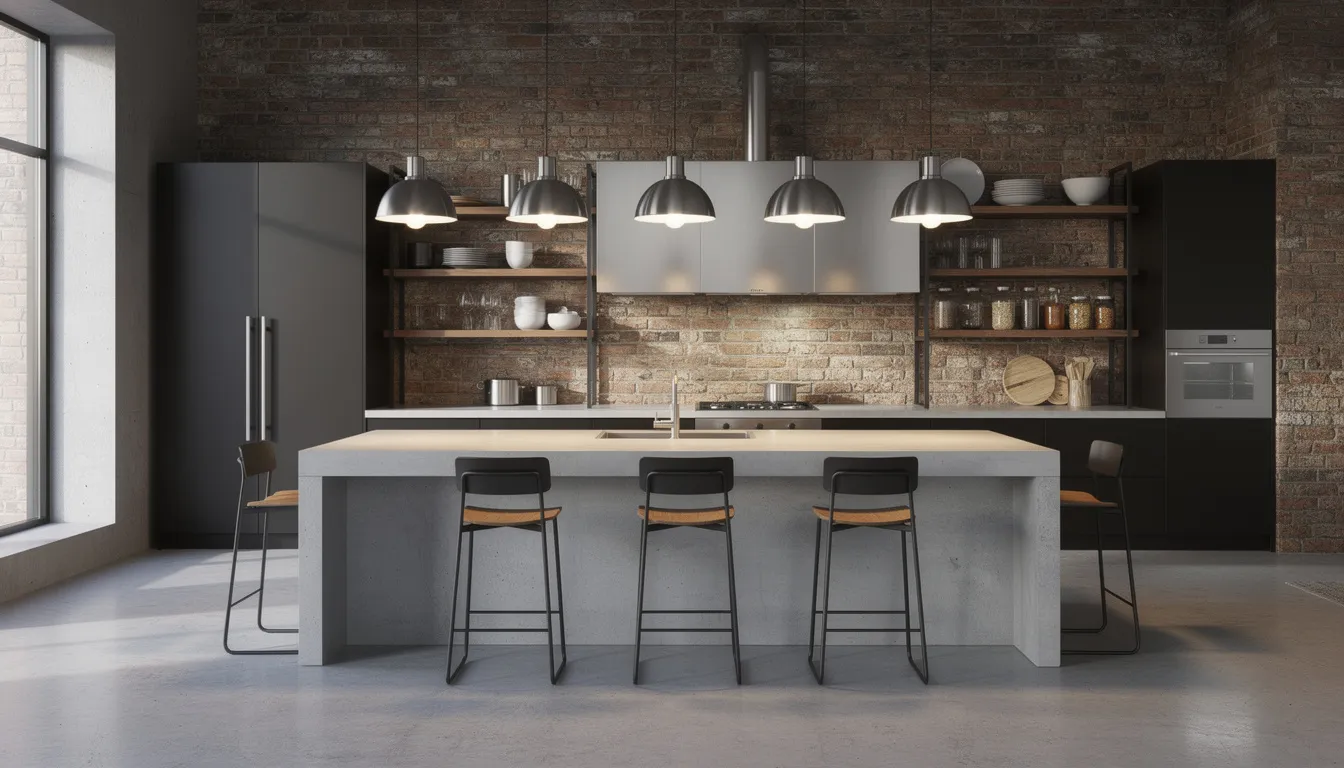
Industrial kitchens featuring exposed beams, brick walls, or concrete elements demand fixtures with character and substance.
- Metal dome pendants over the island—think aged bronze, black iron, or weathered brass—suit the rugged aesthetic
- Track lighting or adjustable fixtures with exposed arms provide flexible task lighting that can be repositioned as needs change
- Warm toe-kick strips soften the hard materials and high-contrast palette common in industrial spaces
- Use dimmers liberally to tame strong contrasts between bright task lights and moody ambient lighting
- Exposed-bulb fixtures with Edison-style LEDs (2200K–2700K) add decorative warmth without sacrificing efficiency
Planning Your Kitchen Lighting Layout Step-by-Step
A successful layered lighting guide ends with a clear planning process you can follow yourself or share with your electrician and designer. Lighting decisions should happen early in the remodel timeline—ideally at the same time as cabinet and appliance layout—to avoid costly rewiring later.
Every plan should map the three layers, choose color temperature, and define control zones before fixtures are ordered. The steps below provide a practical sequence for getting it right the first time.
Step 1: Map Zones and Activities
Start with a scaled view of your kitchen layout, either a printed floor plan from your designer or a careful sketch you create yourself.
- Mark the sink, range, refrigerator, island, and dining or seating areas clearly
- List activities per zone: heavy prep along the main countertop run, quick snacks at the island, homework at the breakfast bar, laptop work at a counter desk, coffee station use, and late-night visits for water or snacks
- Decide where each lighting type is critical—for example, task lighting along the main prep run and over the island, accent lighting in glass cabinets and along toe-kicks, ambient lighting across the entire space
- Note which areas need the brightest focused light and which benefit from softer atmosphere
Step 2: Choose Fixtures and Color Temperatures
With zones mapped, select specific fixture types for each layer and commit to a consistent color temperature.
- Ambient layer: recessed cans, track lighting, or a central fixture
- Task layer: under cabinet strips, pendants over the island, dedicated sink lights
- Accent layer: toe-kick LEDs, in-cabinet lighting, display shelf fixtures
- Choose one primary color temperature (3000K or 3500K) for the kitchen and stick with it across all fixed fixtures
- Verify lumens and CRI from spec sheets before purchase—aim for 90+ CRI wherever possible
- When selecting fixtures, consider how the fixture finish (brushed brass, matte black, chrome) coordinates with cabinet hardware and faucets
Step 3: Define Switching and Smart Controls
Control planning is a distinct step, not an afterthought. Group fixtures into logical zones on separate dimmers.
- All ambient ceiling lights on one dimmer circuit
- Pendants on a second dimmer
- Task under cabinet lighting on a third
- Accent lighting (toe-kicks, in-cabinet) on a fourth
- Incorporate at least one smart controller or scene-capable switch to simplify layered setups—preset scenes eliminate the need to adjust multiple dimmers individually
- Plan switch locations near main entries (so you can light the space when you walk in) and near the pantry or mudroom door for easy access when hands are full
Step 4: Coordinate with Your Electrician or Designer
The best lighting plan on paper fails if junction boxes and wiring don’t match the design during rough-in.
- Review the lighting plan and fixture schedule with your electrician before drywall goes up so everything aligns
- Check local code requirements for spacing of outlets and dedicated circuits for high-draw appliances—these requirements may affect where lights can be placed
- Take photos and mark ceiling and wall locations on-site with painter’s tape to avoid last-minute confusion
- Confirm that all fixtures you’ve selected are compatible with the dimmers specified—LED dimmer compatibility varies, and mismatches cause flickering and humming
- Build in contingency time for any changes that arise once you see the space taking shape
A well-executed layered lighting plan does more than illuminate your kitchen—it transforms how you cook, eat, and live in your most-used room. Statistics show that thoughtfully lit kitchens report 25% higher homeowner satisfaction and measurably fewer injuries from poor visibility. The investment in proper planning pays dividends every time you flip a switch.
Start by mapping your zones, commit to consistent color temperature, and bring your electrician into the conversation early. With the right light in the right places on the right controls, your kitchen becomes a space that adapts to morning rush, evening entertaining, and every moment in between.
